Quick Answer
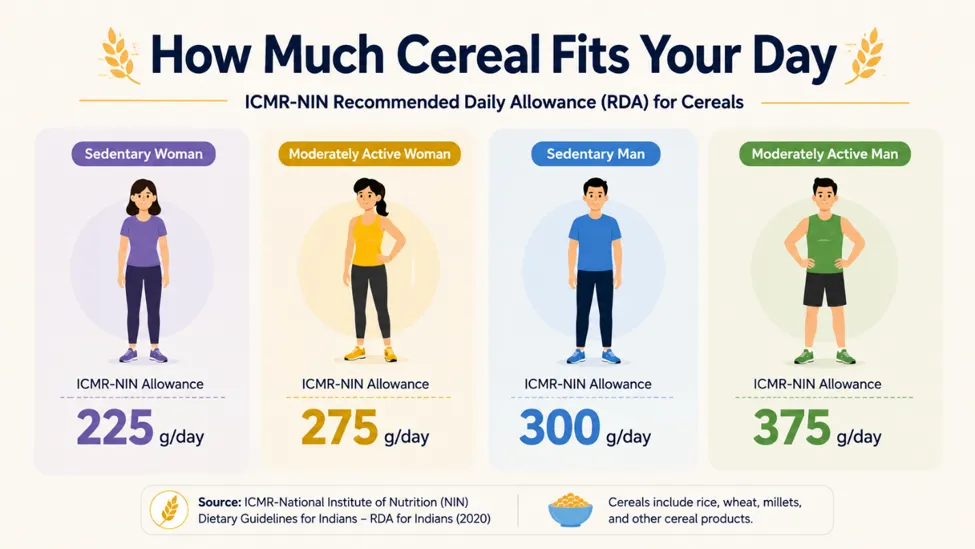
There is no universal number of rotis for weight loss. ICMR-NIN's 2024 Dietary Guidelines for Indians set cereal intake (of which roti is one part, alongside rice and millets) at around 190 to 270 grams a day for sedentary to moderately active women, and 260 to 370 grams for men, depending on activity level. Translated into roti terms using a typical medium roti's raw flour weight, that works out to a broad range rather than a fixed count, and it changes further depending on what else is on the plate. What matters more than the exact number is portion consistency, what you pair the roti with, and total daily calories.
Why "How Many Rotis" Doesn't Have One Universal Answer
Most articles on this topic hand you a flat number, usually two to four rotis a day, without explaining where it comes from. That number isn't wrong exactly. It's just incomplete.
Roti is a cereal. Cereals and millets are one of ten food groups in India's official dietary guidelines, and the recommended intake of that whole group depends on your body weight, sex, and how physically active you are. A sedentary 55-kilogram woman and a moderately active 65-kilogram man have different cereal allowances under the same national guideline. Neither of them is required to get all of that cereal allowance from roti specifically. Rice, poha, dalia, and millets count too.
So a "correct number of rotis" only makes sense once you know two things: how much total cereal your day's energy needs allow for, and how much of that cereal budget you want to spend on roti versus other grains. This is exactly what most existing guides skip.
What's Actually Inside a Roti (and Why Size Confuses Everyone)
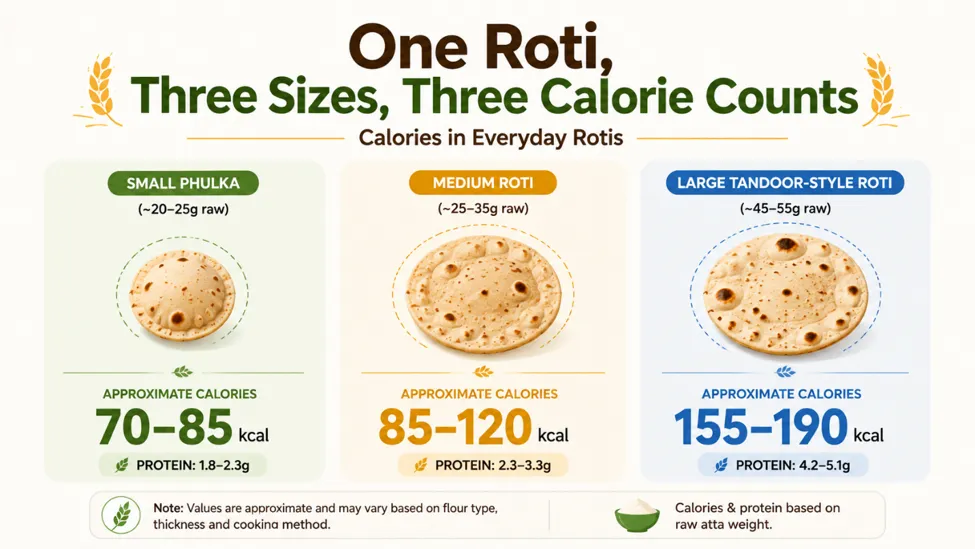
A roti isn't a fixed unit. A small phulka rolled thin at home and a thick tandoor-style roti from a dhaba can differ by close to double in weight, and calories scale with that weight. This is one reason online sources disagree so much on "how many calories in one roti."
According to ICMR-NIN's food composition data, 100 grams of raw cereal (the wheat flour category, which includes atta) provides roughly 343 kilocalories, 9.3 grams of protein, and 6 grams of dietary fibre. A typical home-rolled medium roti uses somewhere around 25 to 35 grams of raw atta. Scaled down from the ICMR-NIN per-100g figures, that puts a single medium roti in the rough range of 85 to 120 kilocalories, before any oil or ghee is added during cooking.
Roti size (raw atta) | Approximate calories | Approximate protein |
Small phulka (~20-25g raw) | 70-85 kcal | 1.8-2.3g |
Medium roti (~25-35g raw) | 85-120 kcal | 2.3-3.3g |
Large tandoor-style roti (~45-55g raw) | 155-190 kcal | 4.2-5.1g |
Adding a teaspoon of ghee or oil while cooking adds roughly 40-45 kilocalories per teaspoon, which matters more over multiple rotis than most people account for.
What ICMR-NIN's Dietary Guidelines Actually Say
This is the part almost no existing article on this topic mentions, and it's the most useful reference point available for an Indian reader.
ICMR-National Institute of Nutrition's revised 2024 Dietary Guidelines for Indians lay out a "My Plate for the Day" model with specific raw-weight food group allowances by body weight, sex, and activity category. For cereals and millets specifically, here's what the guideline recommends for adults with a normal BMI:
Group | Cereals & millets (raw weight, g/day) | Approximate energy from this group |
|---|---|---|
Sedentary woman (55kg) | 190g | ~760 kcal |
Moderately active woman (55kg) | 270g | ~1,080 kcal |
Sedentary man (65kg) | 260g | ~1,040 kcal |
Moderately active man (65kg) | 370g | ~1,480 kcal |
Source: ICMR-NIN Dietary Guidelines for Indians, 2024 revision, Table 1.6
That's the whole cereal group, not roti alone. If a woman with sedentary activity chose to get all of her 190 grams from roti and ate nothing else in the cereal category that day, that would work out to roughly five to seven medium rotis spread across her meals, assuming 25-35 grams of raw atta per roti. If she splits that allowance between roti at two meals and rice or poha at a third, the roti count for the day drops accordingly.
This is the direct answer to "how many rotis." It depends on how much of your cereal budget you're spending on roti specifically, and that budget itself depends on your activity level and body weight, not a flat rule that applies to everyone.
The guidelines also note something that gets lost in most weight-loss content: nationally, cereals already contribute 50 to 70 percent of the average Indian's daily energy intake, well above the 45 percent ICMR-NIN recommends. For many people, the practical lever for weight management isn't cutting roti to a specific low number. It's rebalancing what fills the rest of the plate, since vegetables, pulses, and protein sources are often under-represented relative to cereals in a typical Indian diet.
Roti vs Rice: What the Numbers Actually Show
This comparison comes up constantly, and the honest version is less dramatic than most headlines suggest.
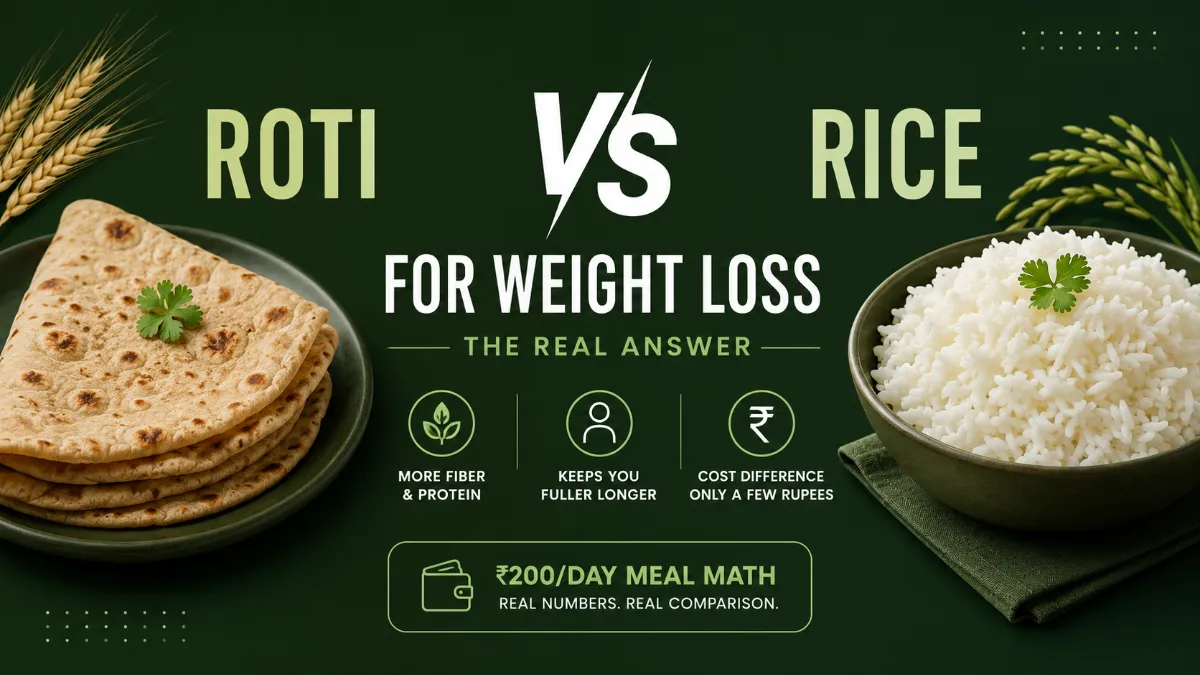
Per 100 grams cooked, white rice provides about 130 kilocalories, 2.7 grams of protein, and 0.4 grams of fibre, according to USDA FoodData Central. Whole wheat roti, made from the same ICMR-NIN cereal composition data referenced earlier, comes out meaningfully higher in both protein and fibre per equivalent raw grain weight, largely because the bran and germ stay intact in atta in a way that's mostly removed during rice polishing.
Per 100g (raw grain basis) | Calories | Protein | Fibre |
|---|---|---|---|
Whole wheat (atta) | ~343 kcal | 9.3g | 6g |
White rice, cooked (100g cooked basis) | ~130 kcal | 2.7g | 0.4g |
The fibre and protein difference is real, and both nutrients support satiety, meaning they can help you feel fuller on a comparable number of calories. But "roti is healthier than rice" isn't the right framing for weight loss specifically. Total calories, portion size, and what accompanies the grain matter more than which grain you pick. Two medium rotis and a cup of cooked rice land in a similar calorie range; the meaningful difference shows up in fibre, protein, and how quickly the meal digests, not in weight loss outcomes on their own.
Does Whole Wheat Roti Actually Help You Lose Weight? What the Research Shows

Here's where a lot of roti content overclaims. Whole grains including wheat roti are frequently marketed as a weight-loss food because of their fibre content, but the clinical evidence on whole grains and body weight is genuinely mixed, not settled.
A meta-analysis of randomized controlled trials published in the American Journal of Clinical Nutrition, covering more than 2,000 participants across 26 studies, found that whole-grain intake did not produce a measurable effect on body weight, though it was linked to a small reduction in body fat percentage. A separate, more recent systematic review reached a similar conclusion: across 19 trials measuring body weight, none reported a significant weight change from whole-grain consumption. Observational studies, which track people's habits over years rather than testing an intervention, tend to show a different picture, generally finding that higher habitual whole-grain intake is associated with lower body weight over time. But observational data can't establish that the whole grain itself caused the difference, since people who eat more whole grains often differ in other health habits too.
Put plainly: whole wheat roti brings real nutritional advantages over refined-flour alternatives, but choosing whole wheat roti over another grain is not, by itself, a proven weight-loss lever. What appears to matter more consistently is total calorie intake and dietary pattern as a whole.
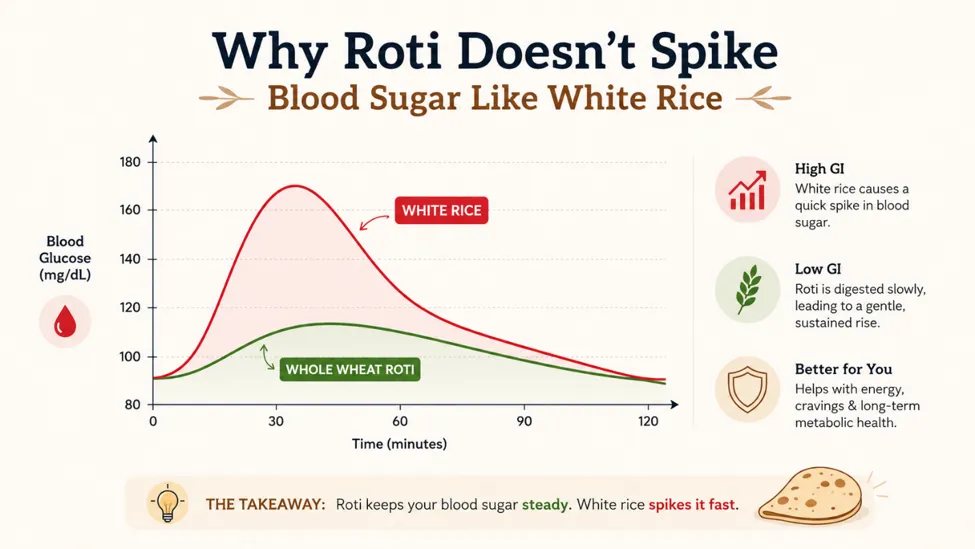
Where roti does have a more consistent research base is glycemic response. A study measuring the glycemic index of whole wheat chapati found a mean GI value of 54, classifying it as a medium-to-low GI food, in a small trial of eight healthy adults. A separate study from an Indian agricultural university's food science department measured whole wheat chapati at a GI of roughly 55, also in the low-to-medium range, with commercial multigrain versions coming in slightly lower still. Lower GI foods are associated with a slower, steadier rise in blood glucose after eating, which some research links to better appetite regulation over the following hours, though the direct link between GI and long-term weight loss remains an active area of study rather than a settled one.
Wheat, Multigrain, or Millet Roti: Does the Type Matter?
Millet rotis, made from jowar, bajra, or ragi, have become popular substitutes for wheat roti, and the swap is often marketed as an automatic weight-loss upgrade. The picture is more nuanced.
Millets are naturally gluten-free and tend to be higher in certain minerals; ragi in particular is notably calcium-rich compared with other cereals. Fibre content varies by millet type, with some varieties matching or exceeding whole wheat. Calorie content per 100 grams raw is broadly similar across wheat and most millets, in the 330 to 350 kilocalorie range, so swapping wheat roti for millet roti isn't a meaningful calorie-cutting move on its own.
What millet rotis do change is texture and cooking behavior. They're denser, don't roll out the same way as wheat dough, and some people find them more filling per roti because of that density. If you enjoy millet rotis and they help you naturally eat a smaller portion, that's a reasonable personal pattern. But there's no strong evidence that millet roti burns fat faster than wheat roti; the mineral and fibre profile differences are real, while any weight-loss advantage is more about how they affect your appetite and portion behavior than a metabolic shortcut.
What You Pair Roti With Changes the Whole Equation
A roti eaten with dal, a vegetable sabzi, salad, and curd behaves differently, in terms of how full you feel and how the meal affects blood sugar, than the same roti eaten alone or with a heavy, oil-rich curry.
Protein and fibre from dal and vegetables slow gastric emptying and blunt the glucose response of the meal as a whole. This is well-established nutrition science, not specific to roti. It means two rotis with a protein and fibre-rich meal can be more satiating than three rotis eaten with just a thin curry and little else.
Cooking method matters here too, though not because of a specific dosage or number. A roti brushed lightly with ghee before serving adds noticeably fewer calories than a paratha layered with oil during rolling and cooking, even though both start from the same flour.
Meal component | Effect on satiety and blood sugar response |
|---|---|
Dal or legumes alongside roti | Adds protein and fibre; slows digestion, extends fullness |
Non-starchy vegetable sabzi | Adds fibre and volume with minimal added calories |
Curd | Adds protein; some research links fermented dairy to modest metabolic benefits |
Deep-fried accompaniments (puri, pakora) | Adds concentrated fat calories that offset roti's fibre advantage |
Sugary or highly processed sides | Raises the glycemic load of the whole meal regardless of roti type |
Common Mistakes That Make Roti Look Like the Problem
A few patterns show up repeatedly in people who blame roti for stalled weight loss, and roti itself usually isn't the actual issue.
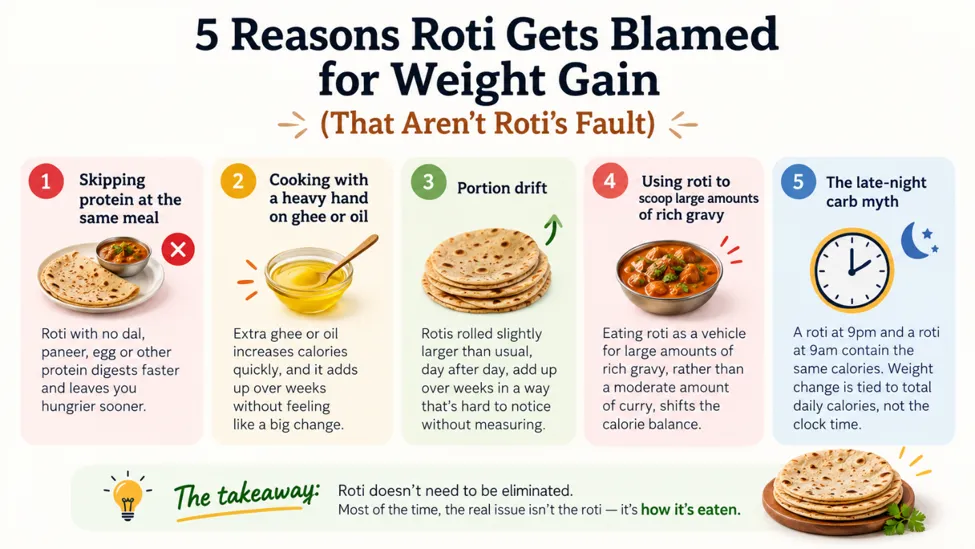
Skipping protein at the same meal is one. A meal of just roti and curry, with no dal, paneer, egg, or other protein source, digests faster and leaves you hungrier sooner, which often leads to snacking later that adds up in calories the roti itself never accounted for.
Cooking with a heavy hand on ghee or oil is another. It's easy to lose track of how many teaspoons go into a batch of rotis over a week, and that fat adds up steadily without feeling like a big change to the meal.
Portion drift also matters. A roti rolled slightly larger than usual, day after day, adds up over weeks in a way that's hard to notice without measuring. And eating roti as a vehicle for large amounts of rich gravy, rather than a moderate amount of curry, shifts the calorie balance of the plate well past whatever the roti itself contributes.
None of this means roti needs to be eliminated. It means the roti count question usually isn't where the actual problem sits.
There's also a timing myth worth addressing directly: the idea that carbohydrates eaten late in the day are automatically stored as fat while the same carbohydrates eaten earlier are not. Total daily calorie balance is what current research ties most consistently to weight change, not the clock time a particular roti was eaten. A roti at 9pm and a roti at 9am contain the same calories. What does vary by time of day, for some people, is appetite and digestion comfort, which is a reasonable basis for eating a lighter dinner if that suits you, separate from any claim about fat storage.
A Practical Way to Think About Your Own Portion
Rather than memorizing a fixed number, it helps to think in terms of what you're already tracking. If you use a food tracking app or a kitchen scale occasionally, weighing a few rotis over a week gives you your actual average roti size, which is more useful than any generic "medium roti" estimate. From there, the ICMR-NIN cereal ranges in the table above give you a ballpark for how much total cereal, across roti, rice, and other grains, generally fits your activity level and body weight.
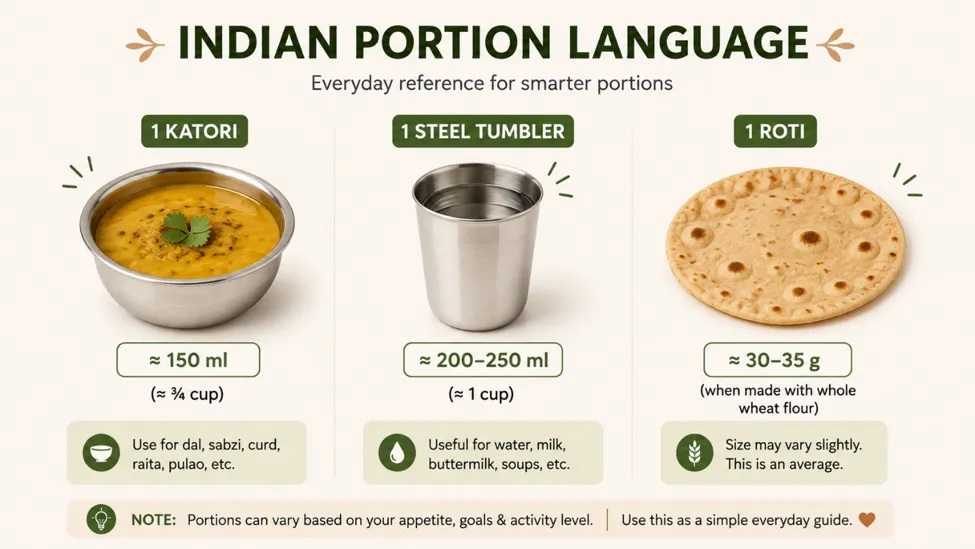
Indian home cooking already has a built-in portion language worth using: a level katori of cooked dal or sabzi, one roti, one cup of curd. Consistency in these household measures across meals tends to matter more for weight management than hitting an exact roti number derived from an online calculator.
It's also worth separating two different goals that get bundled together in most roti content: losing weight and managing blood sugar. Someone managing diabetes or prediabetes has good reason to pay close attention to the glycemic load of a meal, including roti's contribution to it, and that conversation involves a doctor or diabetes educator who can look at actual blood glucose patterns. Someone whose primary goal is weight loss, without a blood sugar condition, is working with a simpler variable: total calories in versus calories used, where roti is one contributor among several. Conflating the two goals is part of why roti advice online is so inconsistent. A number that makes sense for blood sugar management doesn't necessarily match a number that makes sense for calorie balance alone, and neither is a fixed, universal figure.
A related point that rarely gets mentioned: body weight itself changes the practical calculation. The ICMR-NIN cereal ranges above are anchored to reference body weights of 55 kilograms for women and 65 kilograms for men. Someone at a different body weight, or working toward a different target weight, would sit at a different point within or outside these ranges, since energy requirements scale with body size and activity, not with a single fixed number for all adults.
Frequently Asked Questions
Can you eat roti every day and still lose weight?
Yes. Roti eaten daily is not inherently at odds with weight loss; what matters is the total number of rotis relative to your energy needs, portion size, and what you pair them with. Whole wheat roti also brings fibre and protein that refined-flour foods generally lack.
Is roti or rice better for weight loss?
Neither is automatically better for weight loss specifically. Whole wheat roti has more fibre and protein per equivalent grain weight than white rice, according to USDA and ICMR-NIN composition data, which can support satiety. But calorie-for-calorie, both are cereal-based carbohydrates, and total portion size and meal composition matter more than the choice between them.
Which type of roti is best for weight loss, wheat, multigrain, or millet?
There's no strong evidence that one type produces faster fat loss than another. Millet rotis vary in fibre and mineral content depending on the grain, and some people find them more filling due to their denser texture, but calorie content per 100 grams is broadly similar across wheat and most millets.
How many rotis should you eat at night?
There's no fixed number backed by strong evidence specific to nighttime eating. What's more consistently supported is that a lighter, protein-and-vegetable-forward dinner, rather than a particularly heavy meal close to bedtime, tends to fit better with weight management goals generally, independent of roti count specifically.
Does eating roti cause weight gain?
Roti itself doesn't inherently cause weight gain. Weight gain results from consistently consuming more calories than your body uses, and roti is one contributor to total calorie intake among many. Large portions, generous ghee or oil during cooking, and pairing roti with calorie-dense sides are more likely culprits than roti as a food category.

Written By
Vishal Dhenwal
BSc Medical Lab Technologist with 6+ years of clinical diagnostic experience. Founder of Sehatam, translating lab-level clinical knowledge into free wellness guidance for Indians.
Read more about the author →Medical Disclaimer
This article is for informational purposes only and is not medical advice. Nothing here should be used to start, stop, or change any medication or treatment — always consult a qualified doctor first. Read our full disclaimer here.
Related Articles