Quick Answer
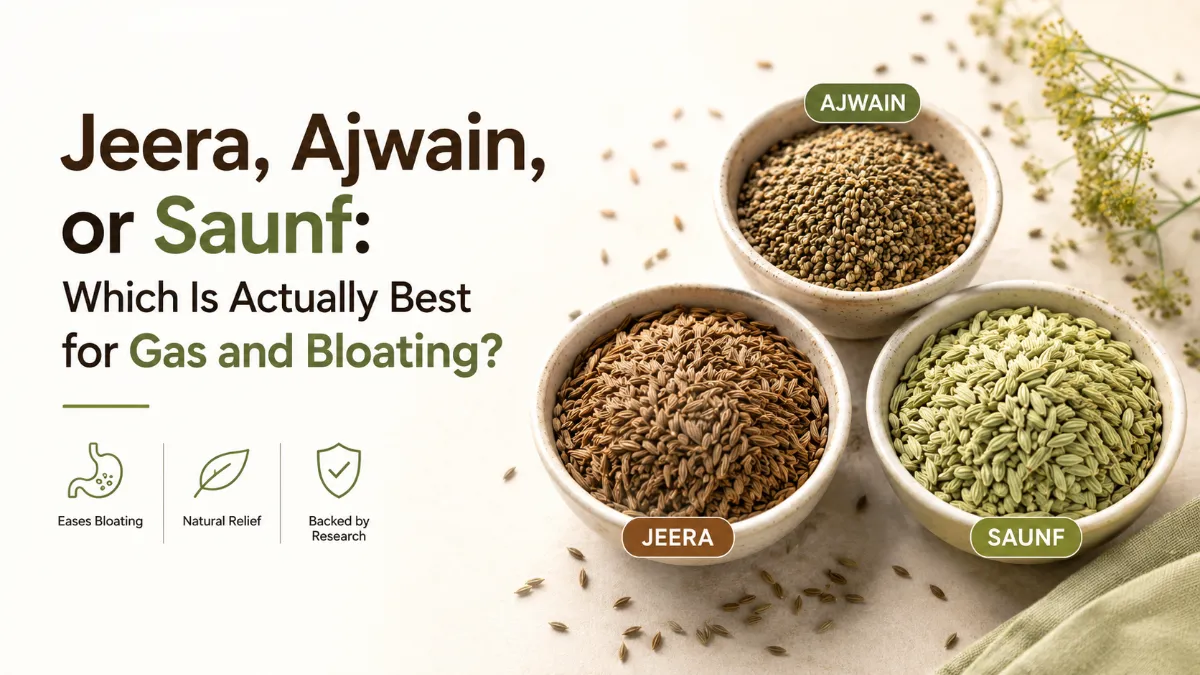
No study has tested ajwain, jeera, and saunf against each other head-to-head, so there is no clinically proven "winner" for gas and bloating. What exists instead is separate evidence for each. Ajwain's thymol content has the fastest antispasmodic action, which helps with sharp, crampy gas. Jeera has the most direct clinical data on bloating and abdominal pain, tested in patients with irritable bowel syndrome (IBS). Saunf is the most studied in combination with other ingredients and works more gradually. A four-seed Persian herbal blend containing all three, plus anise, showed a measurable drop in bloating and dyspepsia scores in a small 2024 randomized trial.
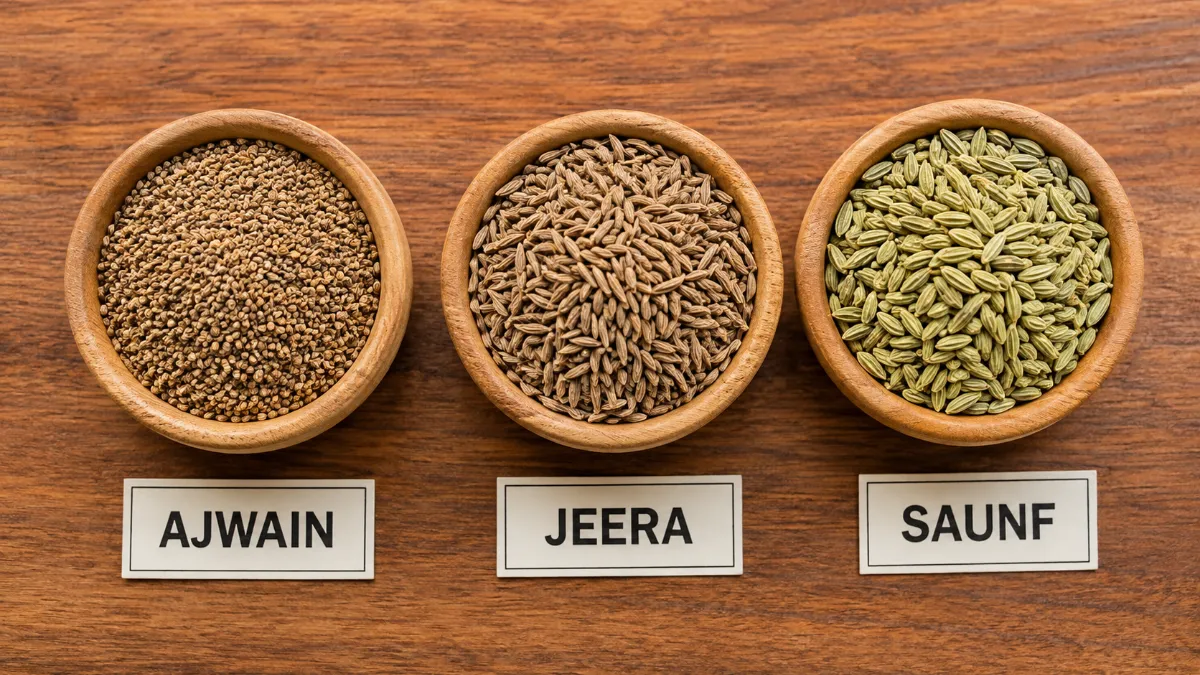
Open the spice box in most Indian homes and you'll find all three sitting within reach of each other. When gas or bloating strikes, the reflex answer usually depends on which grandmother raised you. This ajwain vs jeera vs saunf digestion debate has been settled differently in every household for generations, and almost none of that folk wisdom has been checked against actual clinical research until fairly recently. That's now changed. Gastroenterology and phytotherapy journals have published trials on cumin, fennel, and carom seed extracts specifically for bloating, functional dyspepsia, and IBS. The results don't crown one seed as universally superior. They show each one doing a slightly different job.
What Actually Makes a Spice "Good" for Gas
Gas and bloating happen when swallowed air, undigested carbohydrates, or slow-moving food ferment in the gut and release methane, hydrogen, and carbon dioxide. A spice that helps with this isn't doing something mystical. It's acting through one of a handful of real, measurable mechanisms: relaxing the smooth muscle of the gut wall to ease cramping, speeding up how fast digestive enzymes are released, or altering how quickly the stomach empties its contents.
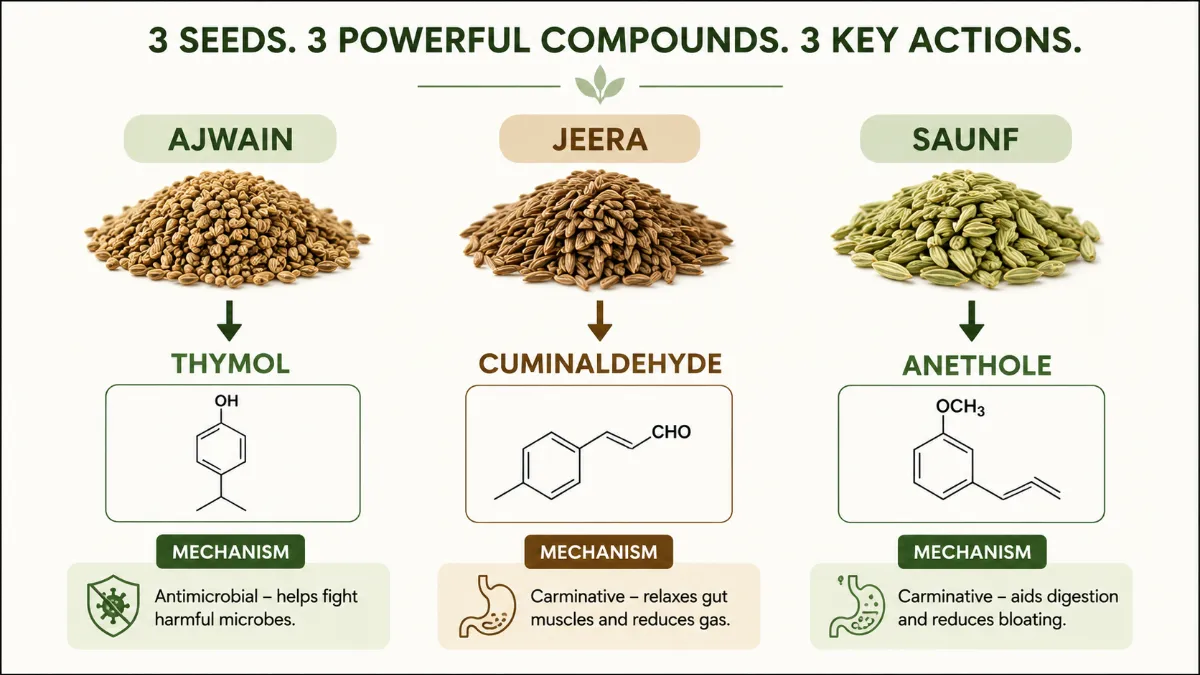
Ajwain, jeera, and saunf all belong to the same botanical family, Apiaceae, and all three contain concentrated volatile oils responsible for their sharp aromas. A pharmacological review of ajwain (Trachyspermum ammi) describes it as having stimulant, antispasmodic, and carminative properties, largely credited to its thymol content. Fennel works differently. Research published in Neurogastroenterology & Motility found that fennel tea has a region-specific effect on stomach motility. It relaxes the upper part of the stomach while promoting movement in the lower part, which is a more nuanced action than a simple gas-reliever.
There's also a separate question of where the gas comes from in the first place, and it isn't always about which spice you add afterward. Fermentable carbohydrates, the kind found in onions, garlic, legumes, wheat, and certain dairy products, are broken down by gut bacteria in a process that naturally produces gas as a byproduct. No seed changes how much of that fermentable material is in your meal. What these spices can influence, at best, is how efficiently that gas moves through and out of the gut once it's already formed, and how much the surrounding muscle contracts or relaxes while that happens.
That distinction matters. "Best for bloating" isn't one property. It's a cluster of different effects, and each seed leans harder into a different one.
Ajwain (Carom Seeds): The Sharpest, Fastest-Acting Option
Ajwain comes from the fruit of Trachyspermum ammi, a plant grown mainly in Gujarat and Rajasthan. Its defining compound is thymol, the same essential oil found in thyme, which gives ajwain its sharp, almost medicinal taste and its reputation as the seed people reach for when bloating feels acute rather than mild.
What the research shows
Ajwain was one of four herbs tested in a 2024 randomized, double-blind, placebo-controlled trial published in the Jundishapur Journal of Natural Pharmaceutical Products, alongside anise, fennel, and cumin, as part of a traditional Persian compound called Persian-FACT. Within the same paper's discussion, the authors reference an earlier randomized clinical trial in which ajwain used on its own significantly reduced the severity of functional dyspepsia. That earlier trial was published in a Persian-language journal, so exact patient numbers aren't independently verifiable through English-language databases, but the finding is consistent with ajwain's broader pharmacological profile documented across multiple reviews.
The mechanism lines up with what Indian households already sense intuitively. Thymol has antispasmodic activity, meaning it relaxes contracted smooth muscle in the gut wall. That's the kind of relief people describe when bloating feels tight, crampy, or "stuck."
When ajwain is the better pick
Ajwain tends to be reached for when gas comes with cramping or spasm rather than just a heavy, full feeling. It acts quickly, which is part of why it's the go-to after a rich, oily meal in most Indian homes.
Jeera (Cumin): The One With the Most Direct Clinical Data on Bloating
Cuminum cyminum, or jeera, is probably the most-used spice in Indian cooking, and it also happens to have the most direct clinical evidence specifically tied to bloating and abdominal pain rather than dyspepsia in general.
A case series published in the Middle East Journal of Digestive Diseases gave cumin essential oil to 57 patients diagnosed with IBS under the Rome II criteria. Abdominal pain, bloating, incomplete defecation, and fecal urgency all decreased significantly during and after treatment. This is a meaningful finding, but it's worth being precise about its limits: it was a case series, not a randomized controlled trial, meaning there was no placebo group to compare against, so some of the improvement could reflect natural symptom fluctuation rather than cumin alone.
Cumin's active compound, cuminaldehyde, is thought to work by stimulating the secretion of pancreatic digestive enzymes and by speeding up intestinal peristalsis, the wave-like muscle contractions that move food and gas through the gut. Faster peristalsis means less time for gas-producing fermentation to build up.
Jeera also appeared as one quarter of the Persian-FACT blend, where the combined formula significantly reduced bloating scores compared to placebo at the one-week mark.
Jeera tends to suit a different complaint profile than ajwain. It's often chosen for a heavy, sluggish feeling after a large or carb-dense meal, rather than sharp cramping.
Saunf (Fennel): Gentle, Cooling, and the Best-Studied in Combination
Foeniculum vulgare, or fennel, is the seed most associated with a mild, cooling effect. It's the one handed out as mukhvas after restaurant meals across India, valued as much for freshening breath as for settling the stomach.
The strongest clinical evidence on fennel comes from a randomized, placebo-controlled trial in Digestive Diseases and Sciences involving 121 patients with mild-to-moderate IBS. A combination of fennel essential oil and curcumin led to a significant drop in IBS symptom severity score after 30 days (a 50.05% relative decrease versus 26.12% with placebo, P<0.001). The important caveat: this tested fennel alongside curcumin, not fennel by itself, so the trial can't isolate how much of that improvement came from fennel alone.
Separately, a 2025 review in Neurogastroenterology & Motility summarizes several other fennel studies. A randomized, placebo-controlled trial on fennel oil found it eliminated infantile colic in 65% of infants compared to 23.7% on placebo. A separate study found that fennel tea, given twice daily to patients recovering from gynecological surgery, significantly shortened the time to first flatus and first bowel movement compared to a plain water control, a fairly direct demonstration of fennel's effect on restarting sluggish gut motility.
Fennel's signature compound, anethole, appears to soothe the intestinal lining and has a documented, mild oestrogenic activity, which shows up again later as a genuine caution rather than a footnote.
Saunf suits people who want something gentle enough for daily use rather than a sharp, one-time fix. It's less about acute cramp relief and more about a steady digestive routine.
Ajwain vs Jeera vs Saunf: Side by Side
Here's how the three stack up against the actual evidence available today, rather than against household reputation.
Spice | Key compound | Best available evidence | Best suited for | Evidence gap to know about |
|---|---|---|---|---|
Ajwain (Trachyspermum ammi) | Thymol | Component of a 2024 RCT (Persian-FACT); referenced standalone FD trial | Sharp, crampy, "stuck" gas after heavy meals | No English-language RCT has tested ajwain alone against placebo for gas specifically |
Jeera (Cuminum cyminum) | Cuminaldehyde | 2013 case series, 57 IBS patients | Heavy, sluggish, post-meal bloating | Case series had no placebo arm, so a control-free improvement can't rule out natural symptom fluctuation |
Saunf (Foeniculum vulgare) | Anethole | 2016 RCT (fennel oil + curcumin), 121 IBS patients; separate motility and infant colic trials | Mild, cooling, everyday digestive support | The strongest RCT combined fennel with curcumin, so fennel's standalone effect size is unclear |
What Happens When You Combine All Three
The household instinct to mix jeera, ajwain, and saunf together isn't far from what researchers have actually tested, even if the exact preparation differs. The Persian-FACT trial mentioned earlier combined ajwain and cumin with fennel and anise into a twice-daily herbal sachet and tested it against a placebo (roasted oats) in 67 adults diagnosed with functional dyspepsia, of whom 55 completed the full two-week trial.
The results were genuinely encouraging, though not uniformly dramatic. Overall dyspepsia severity was significantly lower in the herbal group than placebo at both the one-week and two-week marks (P=0.019). Epigastric pain improved from the first week. Bloating specifically showed a significant improvement at one week (P=0.031), but that difference was no longer statistically significant by the two-week follow-up (P=0.072), a detail the researchers themselves flagged rather than glossed over.
This is a small, single-center trial conducted in Iran, not India, with 55 completers. It's promising evidence for the logic behind combining these seeds, not proof that the exact home-style water infusion Indian households make will produce the same result. The trial used a coarse powder taken directly, not a diluted overnight soak, so treating the two as interchangeable would be reading more into the data than it supports.
The trial also tracked constipation and reflux as secondary outcomes, and both improved significantly in the herbal group compared to placebo, alongside dyspepsia and bloating. That's a useful detail for anyone whose digestive discomfort isn't isolated to gas alone but shows up as a cluster of symptoms after meals.
What the safety data actually showed
One thing that separates this trial from most spice-related wellness content is that it tracked adverse events and lab values, not just symptom relief. Across the two-week period, three mild adverse events occurred in each group. Dry mouth was reported by 9% of the herbal-compound group versus 4% on placebo, headache by 3% versus 4%, and transient abdominal pain by 6% versus 4%. All resolved on their own within a few hours. Blood pressure, liver enzymes (AST, ALT, alkaline phosphatase), and kidney function markers (BUN, creatinine) showed no significant changes in either group over the study period. For a compound consumed at food-adjacent doses over two weeks, that's a reasonably reassuring short-term safety profile, though it says nothing about what happens with months or years of daily use, which hasn't been studied.
Why "Best for Bloating" Depends on What's Actually Causing It
Occasional gas after a heavy or oily meal is a different problem from bloating that shows up regularly, lasts for hours, or comes with pain. A community-based study from northern India published in the Journal of Neurogastroenterology and Motility and a more recent review estimate that irritable bowel syndrome affects somewhere between 4% and 7.9% of the Indian population, based on a multicentric study by the Indian Society of Gastroenterology covering nearly 2,800 IBS patients. Bloating is one of the defining symptoms of IBS, alongside abdominal pain and altered bowel habits.
None of the spices covered here are a substitute for medical evaluation if bloating is persistent, painful, or accompanied by other symptoms that concern you. What the research actually supports is narrower and more useful in daily life: these seeds may ease occasional, diet-related gas and mild dyspepsia symptoms, and some have shown measurable benefit in diagnosed IBS and functional dyspepsia under study conditions. Whether a given bout of bloating falls into that category or needs a doctor's attention isn't something a spice, or an article, can determine. That's a conversation for a gastroenterologist, based on how often it happens and what else comes with it.
It's also worth noting how much of the IBS and dyspepsia research on these spices comes out of Iran rather than India, largely because ajwain, jeera, and saunf are all staples of traditional Persian medicine as much as they are of Indian kitchens. The physiology being studied doesn't change by geography, but it does mean the specific patient populations in these trials, and the exact seed preparations used, weren't drawn from Indian clinics. That's a reasonable gap for future Indian-based research to close, given how central these three seeds already are to home remedies here.
How Indian Households Traditionally Use These Seeds
Across most regions, the patterns are fairly consistent even if the exact seed varies by family. Seeds are commonly soaked in water overnight and strained the next morning, or briefly boiled and cooled before drinking. Ajwain tends to be reserved for after a particularly heavy or fried meal rather than as a daily habit, in keeping with its sharper, more concentrated effect. Jeera water is more often built into a daily morning routine, sometimes on an empty stomach. Saunf is the one most commonly chewed plain after meals, whole and unprepared, functioning as much as a breath freshener as a digestive aid.
Roasting the seeds lightly before use is a common step across all three, thought to mellow the sharper notes and make them easier to digest, though this is a culinary tradition rather than something that has been separately tested in a clinical trial.
Regional variation shows up too. South Indian households often lean on jeera and pepper rasam as the go-to after a heavy meal, while ajwain paratha and ajwain-laced buttermilk are more of a North Indian habit for the same purpose. Saunf is close to universal as an after-meal ritual, served at restaurant counters and home dinner tables alike, regardless of region. None of these regional preferences have been formally studied against each other, but they broadly track with the mechanisms described above: a cooling, gentle seed for routine after-meal use, and a sharper, warming one reserved for when something feels genuinely off.
Who Should Be Careful With These Seeds
These are food-grade seeds used in ordinary culinary amounts, and at that level they're well tolerated by most healthy adults. A few groups warrant more caution, based directly on what the clinical literature flags rather than general internet caution-stacking.
The Persian-FACT trial excluded anyone taking anticoagulant or antiplatelet medication, such as warfarin or aspirin, from participating, a standard precaution given that several of these seeds, including ajwain, have documented effects on clotting pathways. Anyone on blood-thinning medication should check with their doctor before making any of these a regular habit, rather than assuming a kitchen spice is automatically risk-free alongside a prescription drug.
The same trial's authors noted explicitly that the seeds in their compound, which include fennel, anise, and ajwain, may contain compounds that mimic oestrogenic activity, and for that reason recommended against the compound during pregnancy or for individuals with oestrogen-related cancers. Pregnant or breastfeeding women, and anyone managing a hormone-sensitive condition, should raise this with their doctor before treating any of these seeds as a daily wellness habit rather than an occasional culinary ingredient.
It's also worth separating whole seeds and seed-infused water, which is how these are traditionally used, from concentrated essential oils, which is the form used in most of the clinical trials cited above. Essential oils are far more concentrated than a home infusion and are not something to self-administer at trial-level potency without medical guidance.

Frequently Asked Questions
Can I drink ajwain, jeera, and saunf water together every day?
There's no strong evidence against combining them occasionally, and the Persian-FACT trial suggests a combined formula containing all three can meaningfully reduce dyspepsia symptoms over two weeks. But that trial used a measured herbal compound under supervision, not an everyday home infusion, so daily long-term use hasn't specifically been studied. If you notice heartburn, excessive belching, or stomach discomfort building up, that's a signal to scale back rather than push through.
Is ajwain water better than jeera water for weight loss?
Neither has clinical evidence showing it directly causes weight loss. Both may reduce bloating, which can make the stomach look and feel flatter without any actual change in body fat, and that's a distinction worth keeping in mind. Any effect on metabolism or appetite mentioned in wellness content is not something the studies covered here were designed to measure.
Which is better for bloating, ajwain or saunf?
It depends on how the bloating feels. Ajwain's thymol content acts faster on cramping and gassy discomfort, based on its antispasmodic properties. Saunf works more gradually and has better evidence for ongoing digestive support, particularly in combination with other compounds like curcumin in IBS research. Neither has been tested directly against the other.
Can children have ajwain or saunf water for gas?
Fennel has the most relevant pediatric research, including a randomized trial on fennel oil for infantile colic. Dosing for infants and young children is different from adults, though, and this is a decision best made with a pediatrician rather than based on a home remedy alone, especially for very young children.
Do jeera, ajwain, and saunf actually help with weight loss, or just bloating?
The clinical research behind all three is centered on digestion, bloating, and functional dyspepsia, not fat loss. Reduced bloating can create the appearance of a flatter stomach, which is often what people are actually noticing when they credit these seeds with weight loss. None of the trials cited in this article measured body fat or weight as an outcome.

Written By
Vishal Dhenwal
BSc Medical Lab Technologist with 6+ years of clinical diagnostic experience. Founder of Sehatam, translating lab-level clinical knowledge into free wellness guidance for Indians.
Read more about the author →Medical Disclaimer
This article is for informational purposes only and is not medical advice. Nothing here should be used to start, stop, or change any medication or treatment — always consult a qualified doctor first. Read our full disclaimer here.
Related Articles
.webp)